
Email Signatures
How to Write a Legal Disclaimer for Your Email Signature
What the confidentiality notice and privacy information line in email signatures are for, sample wording and how to manage multilingual legal disclaimers.
You often see a short paragraph in small print at the bottom of corporate emails: a confidentiality notice beginning "This email and any attachments are confidential..." or a line about how personal data is processed. These texts are generally known as a "legal disclaimer" or simply an "email disclaimer". This guide explains what a legal disclaimer is for, the different types, sample wording and how to manage it in multilingual correspondence.
Important note: This guide is for general information only and is not legal advice. Decide on the wording your company will use together with your legal adviser.
What is a legal disclaimer?
A legal disclaimer is a short paragraph added below the email signature that gives information on topics such as the confidentiality of the message, the recipient's responsibilities or the processing of personal data. Its purpose is usually one or more of the following:
- To alert the recipient if the message reached the wrong person and ask them to delete it
- To state that the content of the message is confidential
- To provide information on how personal data is processed
- To show the company's official details (registered name, address, registration details)
- To state that views expressed in the email may be personal
It's important to know that a legal disclaimer does not on its own create a contract or provide absolute protection. But it leaves a professional impression, guides the recipient towards the right behaviour and can help the company meet its information obligations.
Types of legal disclaimer
| Type | What it says | Who uses it |
|---|---|---|
| Confidentiality notice | That the message is confidential and a wrong recipient should delete it | Almost all corporate companies |
| Privacy information line | A pointer to the privacy notice on how personal data is processed | Companies that process personal data |
| Company details | Registered name, registered office address, company registration number | Commercial companies |
| Views disclaimer | That the views may be the sender's own | Consultancies, media, academia |
| Environmental note | A reminder not to print unnecessarily | Sustainability-focused companies |
Privacy information line
Data protection laws such as the EU General Data Protection Regulation (GDPR) require organisations that process personal data (data controllers) to inform the people concerned about why and how their data is processed. Adding the full privacy notice to every email isn't practical, so many companies add a short line to the signature and link to the full notice on their website. Whether this line on its own is enough to meet your information obligations depends on your company's processes; assess it with your legal team.
Company details
In many jurisdictions, company law requires businesses to show identifying details on their business correspondence, which can include emails: typically the registered company name, the registered office address and the company registration number, and in some countries further details such as the place of registration or the legal form. The exact requirements differ from country to country and by type of company. Confirm with your legal adviser or accountant how these rules apply to your email correspondence and which details your company needs to show.
Sample wording
The texts below are examples only. Adapt them to your company's needs and have them approved by your legal adviser before use.
Example 1 – Short confidentiality notice:
This email and any attachments are intended only for the named recipient and may contain confidential information. If you have received it in error, please notify the sender and delete it.
Example 2 – Confidentiality and privacy line together:
This message and any attachments are confidential and intended only for the named recipient. You can find our privacy notice on how we process personal data on our website.
Example 3 – With company details:
Example Technology Ltd | Registered office: 1 Example Street, London | Company registration no.: ... This email may contain confidential information; if it has reached you in error, please notify the sender and delete it.
Example 4 – Short confidentiality notice in a second language (German):
Diese E-Mail und etwaige Anhänge sind ausschließlich für den genannten Empfänger bestimmt und können vertrauliche Informationen enthalten. Sollten Sie diese E-Mail irrtümlich erhalten haben, benachrichtigen Sie bitte den Absender und löschen Sie die Nachricht.
Multilingual legal disclaimers
Companies that correspond with international customers want to show the disclaimer in a language the recipient understands. There are two approaches:
- Two languages in one signature: A translation is added below the main-language text. Simple, but the signature gets longer.
- A separate signature per language: Employees use their English, German or other-language signature depending on the language of the correspondence. The signature stays shorter and tidier.
Things to watch for in translations:
- The meaning of legal terms can change from language to language; don't use machine translation without checking it.
- Make sure the text in every language carries the same content.
- When you update the text in one language, update the others too.
The process for preparing a legal disclaimer
A legal disclaimer is a text that several people need to agree on. You can follow these steps:
- Define the need: Do you need a confidentiality notice, a privacy information line, company details, or all of them?
- Prepare a draft: Write a short, plain and clear first version.
- Get a legal review: Have the text approved by your legal adviser or company lawyer.
- Prepare translations: Prepare translations for the languages you correspond in and have them checked.
- Publish centrally: Add the text to all employees' signatures at the same time and in the same way.
- Review regularly: Update the text when company details or legislation change.
For whom, and on which emails?
Most companies use the legal disclaimer on all external correspondence. For internal emails, a disclaimer is usually not considered necessary and can clutter messages. In long email threads with a business partner you correspond with constantly, repeating the same long text in every reply also hurts readability, which is one more reason to keep the text short.
Writing and design tips
- Keep it short: Two or three sentences are usually enough. Very long texts go unread and clutter the correspondence.
- Use a small but readable font size: The text can be smaller than the rest of the signature, but not so small it can't be read.
- Use a muted colour: Shades of grey separate the disclaimer from the main content.
- Put it at the very bottom of the signature: Contact details come first.
- Use the same text across the company: Letting every employee write their own disclaimer creates inconsistency.
- Don't add it as an image: Text added as an image doesn't display in some email clients and can't be searched.
Common mistakes
- Copying a long text found online without a legal review
- Continuing to use the old text after the company name or registration details have changed
- Using a disclaimer in only one language while corresponding with international recipients
- Putting the disclaimer in the middle of the signature and overshadowing the contact details
- Every employee using a different text
Multilingual legal disclaimer management with EcoQrCard
In EcoQrCard's email signature module, the legal disclaimer is managed in one place by the company administrator. When the Include disclaimer text option is switched on, a ready-made confidentiality notice is added in the signature's language. This built-in text does not include a privacy information line or company registration details; if you need these, you can use the Use custom disclaimer text option to enter your own texts for Turkish, English, Azerbaijani, Russian and German.
Setup takes just a few steps:
- On the Definitions → Email Signature page, tick the Include disclaimer text box.
- To use the text approved by your legal adviser, tick Use custom disclaimer text and write it in the box for your main language.
- Fill in the boxes for the other languages you correspond in, or create draft translations with Fill with AI.
- Set the Disclaimer Font Size, check the different languages in the preview and press Save Settings.
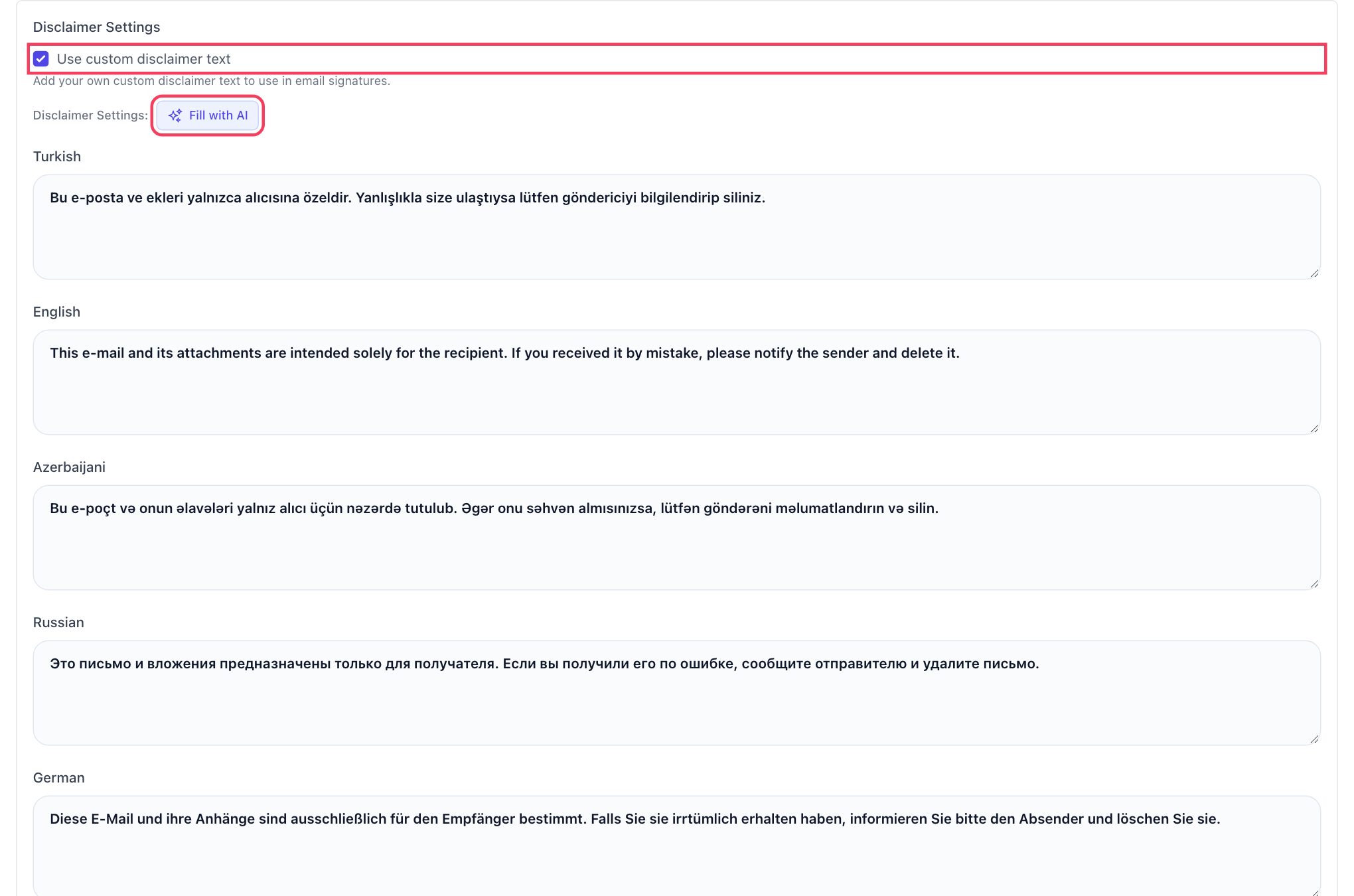
If you have written the text in only one language, the Fill with AI button translates the languages left empty; it doesn't touch boxes that are already filled. With legal texts, always read the translations, or have an expert check them, before saving. If you leave a language's box empty, the signature in that language shows the text from another language you have filled in (Turkish first), so fill in every language you use. The font size of the legal disclaimer can be set separately, so the text stays smaller than the rest of the signature but still readable.
When employees choose the signature language on their own signature page, the labels, job title and legal disclaimer change to that language. Once the settings are saved, every employee's signature page uses the same text; employees cannot change the legal disclaimer themselves, which ensures consistency across the company.
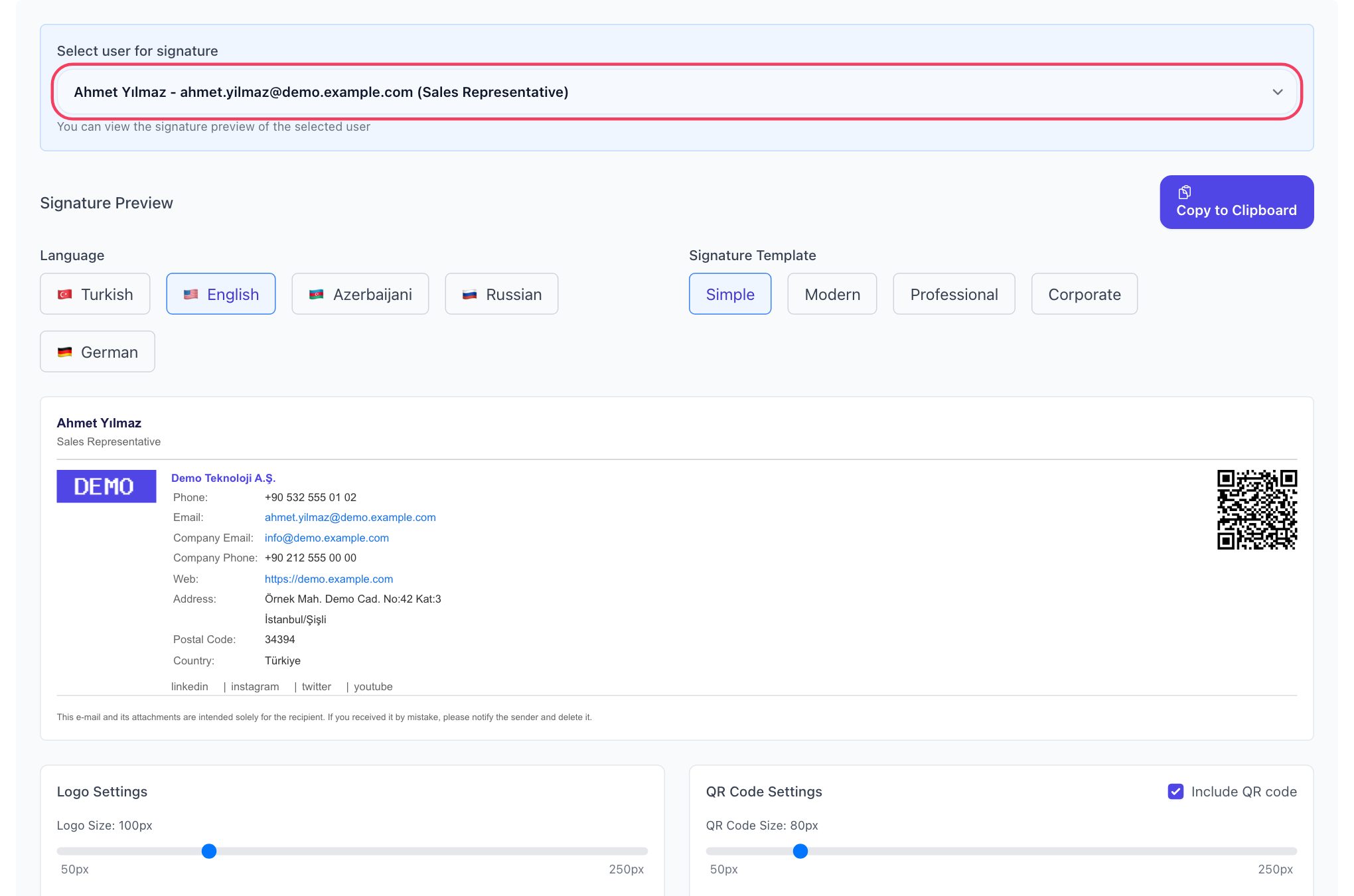
For the other elements of signature design, see our corporate email signature guide; to add the signature to your email client, see our guides for Outlook, Gmail and Apple Mail. The QR code added to the signature lets recipients open your digital business card.
To use a consistent, multilingual legal disclaimer in all your company's signatures, fill in the quote request form and we will plan the setup together.
Frequently Asked Questions
Is a legal disclaimer mandatory in an email signature?
There is generally no legal requirement for texts such as a confidentiality notice. However, in many countries company law requires businesses to show identifying details such as their registered name and registration number on business correspondence, and there may be other rules depending on your sector. Decide which details your company needs together with your legal adviser or accountant.
Does a confidentiality notice protect me legally?
A confidentiality notice does not provide absolute protection on its own. It warns the wrong recipient and shows that the company takes confidentiality seriously. The real way to protect confidential information is to send it to the right recipient, encrypt attachments where necessary and follow internal security rules.
What should I write in the privacy line?
Many companies use a short sentence stating where the privacy notice on the processing of personal data can be found. Assess the content and adequacy of the text together with your legal team.
What language should the legal disclaimer be in?
It should be in a language the recipient understands. For domestic correspondence, your local language is appropriate; with international recipients, English or the recipient's own language. Using a separate signature per language keeps the signature short and tidy.
When I change the legal disclaimer, are employees' signatures updated?
In EcoQrCard, once the administrator saves the settings, the signature page shows the new text for all employees. However, if employees have already pasted their signature into their email client, they need to copy the updated signature again and paste it in place of the old one.